Showing posts sorted by relevance for query dr. ronald walters. Sort by date Show all posts

Monday, September 13, 2010

Gone Too Soon: Scholar Ronald W. Walters Led What Is Considered To Be The First Lunch-Counter Sit-In

 
 Scholar Ronald W. Walters Led What Is Considered To Be The First Lunch-Counter Sit-In
By Matt Schudel
Washington Post Staff Writer
Sunday, September 12, 2010; C01

Ronald W. Walters, one of the country's leading scholars of the politics of race, who was a longtime professor at Howard University and the University of Maryland, died Friday of cancer at Suburban Hospital in Bethesda. He was 72. 

Dr. Walters was both an academic and an activist, cementing his credentials with his early involvement in the civil rights movement. In 1958, in his home town of Wichita, he led what many historians consider the nation's first lunch-counter sit-in protest. Later, he became a close adviser to Jesse L. Jackson as one of the principal architects of Jackson's two failed presidential campaigns.
"Ron was one of the legendary forces in the civil rights movement of the last 50 years," Jackson said Saturday.

Dr. Walters also helped develop the intellectual framework of the Congressional Black Caucus in the 1970s. Some of his political ideas, such as comprehensive health care and a proposed two-state solution to the Israeli-Palestinian problem, were viewed as radical. A quarter-century later, they are part of the intellectual mainstream.

"Many of his ideas now make up the progressive wing of the country," Jackson said. "If it's morally right, it can't be politically wrong."

Two decades before Barack Obama was elected president, Dr. Walters described the political steps an African American candidate would have to take in his 1987 book "Black Presidential Politics in America: A Strategic Approach."

In 2003, he predicted a resurgent white conservative movement in his book "White Nationalism, Black Interests: Conservative Public Policy and the Black Community." When Hurricane Katrina devastated New Orleans in 2005, Dr. Walters became a leading voice in highlighting the inequality that tarnished the bright edges of the American dream.

"Katrina kicked open a very historical door," he said. "It showed us, for example, that poverty's not gone in America and we're not just talking about black poverty."

Beginning in the 1970s, Dr. Walters became known as one of the country's foremost public intellectuals, with frequent appearances in the media as a commentator on public affairs. He was interviewed by Bill Moyers on PBS, commented on cable news shows and wrote opinion columns for newspapers and magazines. 

"As an academic, journalist and crusader, he was in the tradition of W.E.B. DuBois," writer and civil rights leader Roger Wilkins said Saturday. "He was a man who used his intellect and wisdom to make this a fairer and culturally richer country than the one we were born into."
 
Early Days

Ronald William Walters was born July 20, 1938, in Wichita. His father was a musician and had served in the military; his mother was a civil rights investigator for the state. 

In July 1958, when he was leader of the youth council of the local NAACP, Dr. Walters and a cousin, Carol Parks, organized a sit-in protest of the Dockum drugstore in Wichita. Day after day, young African Americans sat at the drugstore's lunch counter, where they were refused service. The protesters sat in silence for hours at a time, enduring taunts from white customers.
Finally, after more than three weeks, the store owner relented, saying, "Serve them. I'm losing too much money." 

The Wichita sit-in and a similar one in Oklahoma City occurred almost two years before the more famous lunch-room sit-ins in Greensboro, N.C., but received little publicity at the time. It was not until 2006 that Dr. Walters received a belated medal from the NAACP for his quiet but effective act of civil disobedience in Kansas. 

"You gain your authenticity through the risks you take," Jackson said Saturday. "He stood up. He marched. He was both scholar and activist." 

In 1963, Dr. Walters graduated from Fisk University in Nashville, where two of his intellectual heroes, DuBois and historian John Hope Franklin, had studied in earlier years. Dr. Walters also sang tenor in Fisk's famed Jubilee Singers.

After being selected for a fellowship at the State Department, Dr. Walters received a master's degree in African studies in 1966 and doctorate in international studies in 1971, both from American University. 

He taught at Syracuse University in the late 1960s and became the first chairman of chairman of Afro-American studies at Brandeis University in Boston before joining the faculty at Howard University in the early 1970s.

He wrote his first books at Howard, became chairman of the political science department and was busy with many outside projects. He worked as a top adviser to Rep. Charles Diggs (D-Mich.), the first chairman of the Congressional Black Caucus. He participated in summit meetings of black executives, political leaders and scholars and in 1977 was a founder of the TransAfrica Forum, a group that led the fight against South African apartheid and sought to improve conditions in Haiti.
During Jackson's 1984 presidential campaign, Dr. Walters was a confidant of the candidate, as well as a street-level political operative.

"He was on the ground with us, going through it with the great unwashed, including me, to reconcile the tensions that existed between elected officials," former Prince George's County Executive Walter K. Curry said Saturday. 

In 1996, Dr. Walters moved to the University of Maryland, where he directed of the African American Leadership Institute and was a distinguished scholar at the James MacGregor Burns Academy of Leadership. His wife, Patricia Turner Walters, said Dr. Walters had recently agreed to return to Howard University as a senior research fellow and lecturer.

In addition to his wife, of Silver Spring, survivors include three brothers, Duane Walters of Atlanta, Terrence Walters of Oklahoma City and Kevin Walters of Bowie; and two sisters, Marcia Walters of Austin and Sharon Walters of Atlanta.

Dr. Walters had recently edited a book about D.C. politics, "Democratic Destiny and the District of Columbia" and was at work on a book about Obama at the time of his death.
In an essay in January, Dr. Walters defended Obama's record in the face of criticism from the left and the right.

"I think that the pundits and the public should face up to one fact," he wrote. "The mess that President Barack Obama inherited will not be fixed in one year, or two or possibly even during his entire term. 

"The media works on a timeframe of instant results. . . . If George Bush had been as criticized and interrogated as much as Obama, perhaps the edifice of problems that now challenge the very viability of America might have been stopped." 


Hear Dr. Ronald Walters On W.E. A.L.L. B.E. Radio:
Topic: 2010 State Of The Black Union
“It Ain’t About Tavis, It’s About Us, & It's About Time!”

Friday, September 17, 2010

Count Me Among The Many Touched And Inspired By Dr. Ron Walters

Count Me Among The Many Touched And Inspired By Dr. Ron Walters
Dr. Jason Johnson 
9/17/2010 

On Friday Sept. 10, Dr. Ron Walters, professor of Political Science at the University of Maryland, passed away quietly after a long battle with cancer. While perhaps not nearly as famous to the mainstream as Cornell West, Skip Gates or Michael Eric Dyson, Ron Walters was for many African-American academics, politicians and me personally an inspiration and a shining example of the responsibilities one carries along with their education.

Dr. Walters was born in 1938 and attended Fisk University and received his MA and PhD from American University in 1971. He was without a doubt one of the most prolific and respected writers on race in the United States, with over 100 publications to his name and more awards than even he cared to count. After working at Howard University for over 25 years, he moved 45 minutes up the beltway to run the African American leadership Institute at the University of Maryland before retiring in part due to his cancer battle.

Dr. Walters was a regular on political commentary shows in the ’80’s and ’90’s. He helped create the groundwork for the Congressional Black Caucus and is credited with starting one of the first sit-in protests in the United States in Witchita, Kans. But none of those reasons are why I am writing about Ron Walters today. My reasons are more much simple and less well known, but I think epitomize the impact he had on so many people in his life.

In the summer of 1996, I had pretty much decided that I wanted to run political campaigns as a career. As an undergraduate at the University of Virginia it’s hard not to catch the political bug. And with mentors such as Larry Sabato teaching that “Politics is a Good Thing” and appearing on television every other week, I saw a great career in consulting and punditry ahead of me.

Of course, I never really knew if that work alone would really be satisfying, if just working on campaigns along was enough to have a life that was personally as well as financially fulfilling. That changed when I met Dr. Walters.

That summer I was in the Ralphe Bunche Institute, a program run by the American Political Science Association to encourage minority students to pursue PhD’s especially in the social sciences. I was enjoying my summer but was pretty much unconvinced. At the time academics came off like distant eggheads to me, all theory and no practical knowledge. Walters ended up being one of our speakers and dinner guests at the Bunche Institute and my entire perspective on what you could do with a PhD, and the impact you could have on practical politics was changed.

Probably the most significant public achievement that Dr. Walters had in his career in most people’s minds was being the campaign manager for Jesse Jackson’s 1984 and 1988 Democratic nomination campaigns. He was in the thick of both of these races, strategizing, organizing and theorizing ways to make the impossible possible. While no slight to Shirley Chisolm, Jackson ran the first “impossible to ignore” campaign by an African American running for president. He made the possibility of a black president very real to all Americans and people across the globe, and he was able to do that in no small part due to Ron Walters.

I was captivated. For the first time in my life I met a black man who was doing exactly what I wanted to do when I was older; make a way in the academic world and make a difference in real politics. At dinner, Dr. Walters was funny, graceful and spent a lot more time answering questions about the campaign to this little group of college kids than he needed to. I was inspired by not only his commitment to his craft, but to his sense of obligation to inspire and encourage others.

In the harsh years of PhD hazing that followed, my mind would occasionally wander back to Dr. Walters, and I would remember that if he could get a PhD in 1971 there was no way I was going to back down from any challenges I was facing almost 40 years later.

This week at the Congressional Black Caucus Conference I’m sure there will be a panel of people discussing in detail the great impact and value of Ron Walter’s life. While my story may not be as profound as some of those men and women on stage, I will clap as loud as anyone else. In celebration of a life not measured in sound bites or best-sellers but in the thousands of lives he touched and inspired. 


(Dr. Jason Johnson is an associate professor of political science and communications at Hiram College in Ohio, where he teaches courses in campaigns and elections, pop culture, and the politics of sports. He can be reached at johnsonja@hiram.edu.)

More Jason Johnson On W.E. A.L.L. B.E.:


Hear Dr. Ronald Walters On W.E. A.L.L. B.E. Radio:
Topic: 2010 State Of The Black Union
“It Ain’t About Tavis, It’s About Us, & It's About Time!”

Thursday, March 18, 2010

Dr. Ronald Walters: Tea Party, Coffee Party: Why Not A Black Party?


Tea Party, Coffee Party: Why Not A Black Party?
by Dr. Ronald Walters
NNPA Columnist
Originally posted 3/17/2010

(NNPA) -- Now we have the Coffee Party which I suppose is a liberal counterpart to the Tea Party that emerged in the Washington, DC area by folks led by Annabel Park a documentary film maker who was horrified by the ugly, menacing and anti-government spirit of the Tea Party crowd that emerged to disrupt the flow of civil discussion about important issues. I’ve been asking, where are the folks who voted for Barack Obama, believing in Hope and Change and pinning for a new post-Bush, post-Conservative America.

Well, many of the ground troops of the Obama movement that were responsible for its grass roots organizing were young adults who went back to school, back to their professional desks or somewhere back to their normal pursuits, but away from politics. In their de-mobilization, they left the field open to the crazies who have mounted a movement not designed to be a force for change, but for the status quo and even for retrogression, wanting to “take back America” from a future they fear. Organizing for Change, the organization created as the repository of the Obama campaign, has largely been ineffective in my evaluation and David Plouffe, its head and Obama’s campaign manager, has recently gone into the White House.

So, what is developing is a discussion at the level of communities across the country about the role of government and the Tea Party and now the Coffee Party are instruments of civic organizing in this process. The Republican party seems to be attempting to grab hold of the Tea Party movement and turn it into an election day force against Democrats vulnerable to elections in this cycle, At this point, the Coffee party has not come that far and the Democratic party has not made its move.

Where does this put Blacks? There is a healthy discussion going on in the black community about the role of President Obama and his responsibility, or the lack of it, to the Black community but with the exception of Tavis Smiley for all the folks who believe that they have to make him accountable to a black agenda, they have not yet put a mechanism on the ground to do it.

There has been a long discussion about the efficacy of a Black political party and many years ago, I joined Ron Daniels and others in an attempt to create one. The irony of that experiment was while half of the people attracted to the idea wanted it to serve as a power-base for elections, others wanted to only exist as a grass roots organizing tool. It eventually split apart along those lines.

Today, it is clear, however, that beyond the general discussion about accountability, there needs to be not only a place where you get down to the “nuts and bolts” about exactly who should be accountable about what, but how to develop effective methodologies of tactics and strategies to achieve it. Thus, whether you call it a party or a posse doesn’t matter, the point is that there is a necessity to mobilize to achieve the ends people are talking about.

A Black party could enable the discussion about accountability to focus on the cabinet agencies where the Federal budget exist to achieve some of the things needed by the black community. Some of the specific programs being rolled out around jobs and a new focus on home foreclosure and etc. look good, but others such as “race to the top” as an educational program looks questionable to me – and the issue is that few of these programs across the board have been developed with the vigorous input and engagement of those for whom the programs are supposed to be designed.

A Black party could also monitor and engage local initiatives more effectively. Where the rubber meets the road is in the local communities and there, mayors, county officials, state legislators and others presumably have some idea of what it takes to make black communities whole, what resources are addressed to that task and what is lacking. A mobilized force could assist in this task of projecting community needs and monitoring whether or to what extent they are met.

What I am suggesting has been happening to some extent with the vigilance of our Civil Rights organizations, the Institute of the Black World 21st Century and the action of progressive black officials at the national, state and local levels.

However, there should be a greater role for citizen engagement and a Black party mechanism could be the key. What we are witnessing is the rush of media attention to these movements, a dynamic that gives them power and places our interests farther and farther into the background. Mobilizing would give us the power to regain the footing to address the truth of our condition.

Dr. Ron Walters is a Political Analyst and Professor Emeritus of the University of Maryland College Park. 

Hear Dr. Ronald Walters On W.E. A.L.L. B.E. Radio:
Topic: 2010 State Of The Black Union
“It Ain’t About Tavis, It’s About Us, & It's About Time!”

Monday, October 04, 2010

Ron Walters Was A One-Man Civil Rights Movement

 
 Ron Walters Was A One-Man Civil Rights Movement
By George E. Curry
NNPA Columnist
Sep 13, 2010
Ronald Walters, the highly-respected political scientist who died last week of cancer at the age of 72, exemplified the true meaning of a public intellectual. To many, the term public intellectual regretfully has become synonymous with selfish private advancement, largely through the writing of books that lead to appearances on television that lead to numerous high-price speaking engagements and lofty appointments in academia.
Ron Walters, on the other hand, used his intellect to disturb the status quo, to advocate for Africans and African-Americans with no thought of enriching himself. The scholar-activist followed in the rich tradition of fellow Fisk University graduates W.E.B.DuBois and John Hope Franklin. Ron’s activism took on many forms. He was issues adviser to Jesse Jackson during his 1984 and 1988 presidential bids. Over the years, he sat quietly in the background as members of the Congressional Black Caucus executed strategies he had devised to advance the interest of Blacks. Not only did he advise African-American leaders and elected officials, he spent many hours – at no charge – speaking to community groups.
I led a crusade to force Ron to start charging for speaking engagements. He and I were serving on a panel at Columbia University years ago and, in passing, he mentioned that he had agreed to serve on the panel for only expenses.
“Ron, I am getting paid and they are taking care of my expenses,” I told him. “And others on this panel are getting paid. You must stop letting people exploit you like this.” I told him that if universities could pay thousands of dollars to rappers, they could afford to pay for his exceptional intellect. A couple of months later when I saw him, Ron told me he had learned his lesson. That wasn’t surprising because Ron was always a quick study.
Ironically, the last time I saw Ron, less than a year ago, was when we were both serving on a panel discussing politics at the New Carrollton, Md. public library; it was sponsored by the Prince Georges County chapter of the Southern Christian Leadership Conference (SCLC). And, yes, we participated in the event for free. Even though Ron was finally charging for speaking engagements – but not at the $15,000-plus level most public intellectuals receive – he never stopped giving to community groups that could not afford to pay him anything.
There was a fun side to Ron as well. One of the hottest tickets in the nation’s capital was an invitation to the annual Christmas party that Ron and his wife, Pat, gave each year in their Silver Spring, Md. home. It was a time of great discussion with old and new friends, good food and plenty of laughter. Whenever I was in town, I made it a point to attend.
Ron was a brilliant low-key brother who preferred to focus on issues, not personalities. In fact, it wasn’t until February of this year that many of us learned about his youth activism. And that was because he was responding to a column I had written during Black History Month.
“My friend George Curry reminded me of something in his article on ‘Being True to Black Historymakers’ when he said that in this year when we celebrate the 50th anniversary of the Greensboro Sit-in that we must remember that ‘they were not alone.’”
Ron continued, “It is true that these students were not alone because in August of 1958, those of us in the NAACP Youth Council of Wichita, Kansas targeted the lunch counter at the Dockum Drug store in the heart of town for a sit-in demonstration because they, like so many other establishments, did not let Blacks eat there. After about six weeks of sit-ins that drew 20-40 young participants, we successfully desegregated not just Dockum Drugs, but the Rexall chain of drug stores in that state.”
What Ron deliberately left out of the column was that he was the leader of that sit-in movement in his hometown.
Ron Walters was a strong, consistent and unapologetic voice for African-Americans and Pan-Africanism. In fact, one of his email addresses was panaf@aol.com. He was a strong proponent of developing a Black Agenda, even in the age of Barack Obama.
In one recent column, Ron ticked off a series of issues that he said should be included in the Black Agenda: health disparities, police brutality, equal access to education, voting rights enforcement, access to credit, racial profiling, ex-offenders voting rights,  housing and equal employment.
“It is the task of modern civil rights organizations to make the demand that equality be achieved, that fairness be the rule of conduct of all American institutions,” he wrote. “It is their role to demand closure of the gaps in civil and human rights, even though much of the technical and political work is carried out by our elected leaders. It is their job to mobilize Black people and our allies, to influence institutions to behave in ways that honor our citizenship and humanity in the 21st century.”
By that definition, Ron Walters was a civil rights movement by himself.
 
(George E. Curry, former editor-in-chief of Emerge magazine and the NNPA News Service, is a keynote speaker, moderator, and media coach. He can be reached through his Web site, http://www.georgecurry.com/. You can also follow him at www.twitter.com/currygeorge.)

Hear Bro. George Curry & Dr. Ron Walters On W.E. A.L.L. B.E. Radio:
2010 State Of The Black Union
“It Ain’t About Tavis, It’s About Us, & It's About Time!”
 
More Dr. Ron Walters On W.E. A.L.L. B.E.:
http://weallbe.blogspot.com/search?q=dr.+ronald+walters
 

Friday, June 25, 2010

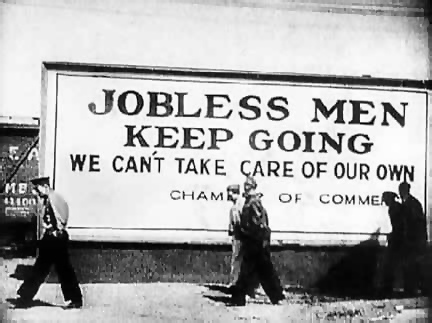
Dr. Ron Walters: Let’s Take Back Our Jobs

 Let’s Take Back Our Jobs
By Dr. Ron Walters
NNPA Columnist

(NNPA) - I hear some folks saying they want to take back their country. I want to take back our jobs. I have just read a study produced by Vice President Joe Biden’s office about the performance of Stimulus funding which shows that it has taken many of the “shovel-ready” projects that were proposed 18 months ago that amount of time to be really ready now. This has led the New York Times to note that there will be an “explosion” of Stimulus funded construction projects this summer. In fact, the White House has dubbed the coming employment opportunity as “Stimulus Summer.”

However, I recently drove by several construction projects in the Washington, DC and Silver Spring, Md. area and noted that the work force is still rich with Hispanics, a few White supervisors and almost no Blacks. So, the coming explosion of construction jobs causes me to ask whose hands will be on these federally funded shovels at a time when the unemployment levels in the Black community, and especially among Black males is now well known to be horrific.

While there has been a great deal of angst that I and others have expressed about the lack of accountability of this administration to the Black community, the fact is that the president has placed a great deal of money on the table for jobs. And while his administration has not done the most effective job of targeting those funds to the Black community, it would appear to me that we should acknowledge that and go after the construction related jobs ourselves instead of waiting for them to be delivered to our doorstep.

Likewise, I recently wrote about the attempt of the Congressional Black Caucus to get legislation out of the House that target job creation to local areas through direct funding. These legislative initiatives are being held up in the House and Senate by politicians who care more about posturing in an election year over how frugal they have been with public money by supporting deficit reduction over the pain people are suffering. The catch here is that the voting public is skewed toward the middle and upper classes, people who need government less and who are more critical about government spending for social programs. They invariably set the tone in politics and public opinion.

So, with many of the avenues to obtaining substantial employment resources in the regular political process blocked the question is what do we do? One example is provided by the Virginia NAACP, whose Executive Director, King Salim Khalfani, supported by the Black Business Alliance of Virginia have vowed to take direct action to blockade federally funded construction sites with trucks. The threat of this action, issued from the steps of Richmond City Hall, called on HUD to shut down construction projects that discriminate against Blacks by not providing fair employment. Khalfani vowed, “There will be no more developments in this town that Black businesses and communities are not involved in the planning or development thereof.” We will see how HUD responds.

But what if this attitude was adopted by Black political and economic leaders across the country? What if they stopped waiting on Obama to deliver jobs and challenged those with the financial resources he provided to distribute them fairly in creating employment? Many firms, such as the Atlanta-based Choate Construction company are practicing out-and-out employment discrimination and they get away with it because HUD approves their “diversity” numbers – a concept that doesn’t have to include Blacks at all. The remedy here may be to bring more law suits.

So, as we see highway construction jobs go from 1,750 last July to over 10,700 this July; home weatherization project reach 82,000, 27 times more than last July; clean-water projects reach 2,828, 20 times more than last July; and 218 federal building under construction this July, it seems that the time-tested tactics of using the courts and direct action should be used with a much greater frequently than they are at the moment.

Dr. Ron Walters is a Political Analyst and Professor Emeritus of the University of Maryland College Park. His latest book is “The Price of Racial Reconciliation”(University of Michigan Press).

Hear Dr. Ronald Walters On W.E. A.L.L. B.E. Radio:
Topic: 2010 State Of The Black Union
“It Ain’t About Tavis, It’s About Us, & It's About Time!”

Tuesday, February 23, 2010

2/24/2010*9PM C*W.E. A.L.L. B.E. Radio: The 2010 State Of The Black Union

Celebrating 3 Years Strong & Still Got It Going On

February 2010 Theme: Moment. Momentum. Movement...

Air Date: Weds. February 24, 2010


Time: 9 PM C/10 PM E/7 PM P

Call-in Number: 646-652-4593

Listen To The Show:
http://www.blogtalkradio.com/weallbe/2010/02/25/tha-artivist-presentswe-all-be-radio

Topic: 2010 State Of The Black Union
“It Ain’t About Tavis, It’s About Us, & It's About Time!”

"Those who profess to favor freedom, and yet depreciate agitation, are men who want crops without plowing up the ground."
~Frederick Douglass

The Key Segments Are As Follows…

9pm C-9:30pm C
Subject: Where Do We Go From Here? The Obama Administration & The Black America Agenda


Our Esteemed & Honorable Guests Include

*Bro. George Curry
Former editor-in-chief of Emerge magazine and the NNPA News Service, is a keynote speaker, moderator, and media coach. He can be reached through his Web site, http://www.georgecurry.com. You can also follow him at http://www.twitter.com/currygeorge.

*Dr. Ronald Walters

Until the end of 2009 Dr. Walters served as director of the African American Leadership Institute and Scholar Practitioner Program, and as a distinguished leadership scholar at the James MacGregor Burns Academy of Leadership @ The University of Maryland. A true “scholar activist”, Dr. Walters has penned seven books, published more than 100 academic articles and served as a campaign manager and consultant for the Reverend Jesse Jackson during his two presidential bids and was a policy adviser for Congressmen Charles Diggs and William Gray. During the 2000 election season, Walters worked as a political analyst for Black Entertainment Television's Lead Story. He is a regular guest and commentator for several political talk shows on radio and television.

***

9:30pm C-10pm C

Subject: A Jena State Of Mind: An Unbelievable Jena 6 Update

Esteemed & Honorable Guest
*Bro. Marcus Jones, The Father of Jena 6’s Mychal Bell
Activists Unite!!! Bro. R2C2H2 Tha Artivist (left) With Schlumberger 2's Sis. Tawanna Thierry and Jena 6's Marcus Jones @ The National Action Network Conference in Memphis Friday April 4, 2008

For More Jena 6 News:
http://weallbe.blogspot.com/search?q=jena+six


***

10pm C-11pm C
Subject: The State Of Education: Boycotting & Dismantling A System Of Low Expectations
A Town Hall Meeting
 Copyright By R2C2H2

Esteemed & Honorable Guests…


*Sis. Margaret Block

Civil Rights Legend/ Activist & Co-Organizer Of The 2010 Cleveland, MS, Schools Boycott

*Bro. Kevin Williams
PRESIDENT OF PTA
D.M. Smith Middle School
Cleveland, MS & Co-Organizer Of The 2010 Cleveland, MS, Schools Boycott

School Boycott In Cleveland, MS....
http://weallbe.blogspot.com/2010/02/school-boycott-in-cleveland-ms.html


****

Want More???
Want To Hear More Tha Artivist Presents…W.E. A.L.L. B.E. Radio??? Click On The Following Link:
http://www.blogtalkradio.com/weallbe

E-mail Us Your Questions And Comments @ r2c2h2@gmail.com
As Always Please Spread The Good News!!!


See Also...


"Real Talk With Tha Artivist" TV Show On Memphis Comcast Channel 17


Mondays @ 8pm Central


~~~~~~


Check Out W.E. A.L.L. B.E. TV!!!


~~~~~~


To see or rather "hear" how far W.E. A.L.L. B.E. News & Radio has come please listen to the first broadcast, Jan. 7, 2007:
http://www.blogtalkradio.com/weallbe/2007/01/07/tha-artivist-presents


Also check out how good we were in "2008 a.k.a. The Year Of Citizen Radio":
http://weallbe.blogspot.com/2009/01/we-all-be-news-radio-made-2008-year-of.html


~~~~~~
*Support W.E. A.L.L. B.E. News & Radio!!!*

The W.E. A.L.L. B.E. Needing Funds Drive For W.E. A.L.L. B.E. News & Radio Begins...
http://weallbe.blogspot.com/2008/12/we-all-be-needing-funds-drive-for-we.html

W.E. A.L.L. B.E. Supporting W.E. A.L.L. B.E. News & Radio: Buy Art & Gear For 'The Cause' Today!!!
http://weallbe.blogspot.com/2008/12/we-all-be-supporting-we-all-be-news.html


~~~~~~


W.E. A.L.L. B.E. News & Radio Reps Black History 365 Days A Year!!!
http://weallbe.blogspot.com/2008/02/we-all-be-news-radio-reps-black-history_29.html


~~~~~~

Celebrate Black History And Love All Day Every Day With Works By Tha Artivist:
http://weallbe.blogspot.com/2008/02/celebrate-black-history-and-love-all.html


~~~~~~


Buy The Award Winning James Reese Europe: Jazz Lieutenant


*Named To The Smithsonian Institute's Jazz Books For Kids And Young Adults List*
Video: James Reese Europe: Jazz Lieutenant Commercial


http://www.youtube.com/watch?v=jluUY_n7UC0


Official Website:


Buy The Book @ Amazon.com

~~~~~~


$ Millions Of Dollars In Scholarships, Internships & Job Offers $
Please Visit


~~~~~~

Check Out "The Empowerment Hour" Hosted By Bro. Kermit Eady Every Saturday @ 6 PM EST/ 5PM CST


http://www.blogtalkradio.com/EadyAssociates


~~~~~~


Get The Barack Obama Holiday Inaugural Gift Package By R2C2H2 Tha Artivist!!!


Monday, August 30, 2010

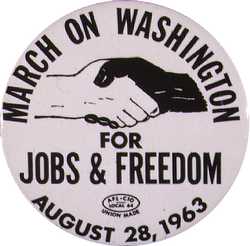
Dr. Ron Walters: August 28: March For Jobs And Justice Where Ever You Are

August 28: March For Jobs And Justice Where Ever You Are
by Ron Walters
NNPA Columnist

(NNPA) - We have to thank Rev. Al Sharpton and other Civil Rights leaders for turning our attention to the atrocity planned by Glenn Beck, Conservative Fox TV talk show host, to have a rally on the Lincoln monument on the anniversary of the March on Washington.

Rather than “restoring honor” as they say, this march, heavily supported by the National Rifle Association is a perversion of the progressive spirit of the original nonviolent march, which held out the hope of racial reconciliation and that America would finally cash a check of justice that would allow all of us to invest in the great project of Democracy.

Glenn Beck is a White nationalist who frequently says that progressivism is the problem with democracy, so he and his Tea Party henchmen want to return America – virtually – to honor a set of values that were around when black people were still being lynched. I agree that he must not be allowed to appropriate the day of the great March and the values that we are still attempting to protect and uphold, so I will be there in Washington.

At the same time Rev. Jesse Jackson, Sr. is leading a March in Detroit, Michigan on August 28 to highlight the fact that the economic Stimulus and therefore, jobs have not reached many black communities and that going forward, Detroit, a City that is 82 percent black and economically challenged, is a symbol that we need a new national urban policy.

Rev. Jackson is right to make clear the fact that jobs is the great issue of our times and where better to make that case than in Detroit.
Also, many people from New Orleans will not come to Washington because they will be commemorating the Katrina Hurricane damage and resurrection that weekend. In that event, I am told they will include elements of the other marches.

But some national news organizations are planning their own five-year look at New Orleans and there are primary elections that day in the State, so that weekend also means that other events will have to struggle for press attention.

In any case, I think that people, especially in this economically challenged environment, should march where they are. If they can come to Washington, DC, or Detroit, or go to New Orleans, fine, but there is work to be done right there at home. It strikes me that, in sympathy with the national marches, local organizations could plan jobs marches to their local workforce agencies, city halls, construction projects where there are no blacks working, and other places where the demand for jobs by local people is a logical act.

Many of us have talked about “civic engagement” well here is an opportunity to do just that, when the national spotlight could connect a national march to one held by a local community.

Perhaps this is a good idea that come too late, but I am reminded that many folks could not come to Washington, DC on August 28, 1963 and so they had local events.

For example, I marched on Woodward Avenue in Detroit with hundreds of thousands of people and heard a version of the “I have a dream” speech a few days before it was given in Washington, DC. The same could be said about the Million Man March: people came by the boatloads in 1995, but by the celebration of the 10 year anniversary, an effort was made to urge folks to have local marches to highlight the values of the original march in their communities.

Finally, there is another reason why blacks should try out their local mobilization legs and that is the elections that are coming down the pike this fall.

I will say more about the elections later, but it strikes me that since the National Coalition of Black Civic Participation is a sponsor of the March in Washington, DC that is sign that they are making a move to get organization thinking about how they will organize to get out the vote later on.

So, these marches are about jobs and justice and respecting the values of the movement for which so many people gave their lives, time and energy. But they are also “right now” oriented to the present crisis of unemployment and to prevent the conservative movement from distorting Dr. King’s dream, but also to keeping political power in the hands of those who can help us best.


Dr. Ron Walters is a Political Analyst and Professor Emeritus of the University of Maryland College Park. His latest book is “The Price of Racial Reconciliation”(University of Michigan Press).

Hear Dr. Ronald Walters On W.E. A.L.L. B.E. Radio:
Topic: 2010 State Of The Black Union
“It Ain’t About Tavis, It’s About Us, & It's About Time!”

Thursday, May 13, 2010

Dr. Ron Walters: Take Racism Out Of Immigration Reform


Take Racism Out Of Immigration Reform
by Ron Walters
NNPA Columnist

(NNPA) - For my money the debate over immigration reform is far too narrow. Our civil rights leaders have followed the predictable dynamic created by Hispanics who have justly mobilized to normalize their status in America. We should support them because the stakes of strengthening our coalition at this moment in history will bear substantial fruit as both groups become a larger part of American society, its political system and its economy. So, it is a civil rights struggle to oppose the racist law passed by the Arizona legislature to profile Hispanics and relate any illegal acts to their immigration status.

Nevertheless, it is also a civil rights struggle to use this moment to finally eliminate the racism in immigration law in general. This means that our take on immigration reform should be addressed more clearly and forcibly to creating fair opportunities for people of African descent to enter this Country along with everyone else.

Over the years some progress has been made. For example, the initial quota established in 1924 which allowed 1,100 Africans to enter a year, increased to 1,400 by 1952. After African countries became independent in the 1960s, immigration to the US increased, reaching 40,000 per year by 2000. Between l960 and 2008 African immigration to the US amounted to 1.4 million, Still, this constituted only 3.8 percent of the total foreign population of 38 million in that period.

The result of such a restrictive entry policy for Africans has been that largely those with economic resources have been eligible to apply for immigrant status. Thus, while 23 percent of Americans in general have college degrees, 51 percent of African immigrants have college degrees. This has also meant that while the myth of the African cabdriver persist, the real story is that the average wage of Africans is among the highest in the nation second only to Asians. The second generation of African born immigrants in the US are now prominent in American universities and in many areas of corporate and human service occupations.

The situation of Haitian immigrants, long a source of vexation to many, was exposed again by the recent hurricane as blatantly racist. Some Haitians who survived the hurricane and made it to the US found themselves locked up in detention centers in Miami for the lack of visas. This is consistent treatment of Haitians who have been routinely and vigorously turned away from US shores while white Cubans have enjoyed a Cold War policy that has privileged their immigration to the US. Between 1980 and 2008 total Haitian immigration to the United States was 535,000 but Cuban immigration during that same period was nearly one million.

The arrangement for Cuban immigrants was always based on a political fiction because Cuba has been no real threat to the United States, so the comparative treatment of Haitians and other Afro-Caribbean immigrants must be justified on the basis of a racial prohibition. The test is that if Cubans immigrants had been black instead of white would they have been allowed to come?

Apparently, the US was paying no attention to Mexican/Latin American immigration as Latin American immigration in that period constituted 53 percent (32 percent Mexican ) of all sources, with over 10 million undocumented people from that region in the country. Meanwhile it paid attention to Haiti, since only 76,000 immigrants were “unauthorized” from Haiti in that same period.

One of the routes to the stabilization of Haiti in the post-hurricane era would be to allow humanitarian immigration. How would it look to have satisfied the Latin American dimension of the immigration problem on those grounds while the African dimension of it festers? Generally, I believe that there can be no “comprehensive immigration” solution that does not take into consideration people of African descent. The Obama administration should try to eliminate the racial dimension of immigration policy, but then it may be banking on not having another problem. But it is also fair to ask why there is no problem created by African American mobilization on this matter, why no mobilization by African born or Haitian born immigrants?

One source of the future expansion of the “African American” population is by natural birth rates, but another is by immigration, to miss this opportunity to elimination racist immigration is to limit the future power of our community.

Dr. Ron Walters is a Political Analyst and Professor Emeritus of the University of Maryland College Park. His latest book is “The Price of Racial Reconciliation”(University of Michigan Press).

Hear Dr. Ronald Walters On W.E. A.L.L. B.E. Radio:
Topic: 2010 State Of The Black Union
“It Ain’t About Tavis, It’s About Us, & It's About Time!”

Monday, August 30, 2010

Dr. Ron Walters: Institutional Racism In Congress


Written by Ron Walters
Thursday, 12 August 2010 13:06

Washington Informer - Opinion 

Institutional Racism In Congress

The sensational exposes about Rep. Maxine Waters have failed to relay an important fact to the public about why she arranged meetings between herself, a bank, and former Treasury Secretary Paulson. It had to do with trying to support the survival of the Black economic infrastructure, which had been hit hard by the financial crisis the country faced. Rep. Waters has for a long time been an advocate for Black businesses in the Congress, essentially because they had been marginalized and excluded routinely.


Here, she took over the role of Parren Mitchell of Baltimore who was their champion, but who left the Congress with an illness. I was invited to a meeting by Rep. Waters last November to provide a brief analysis of where we were as a community in the throes of the economic crisis to a small invited group of representatives of Black economic organizations.

In the room were the leaders in fields such as automotive, banking, financial services, broadcasting and others. All told tails of ruin and destruction of businesses they were experiencing because of the inability to access capital.

The head of Black auto executives, for example, said that their dealerships in the General Motors system had dived from 63 to 26 and if there was no help from GMAC (which was receiving federal funds) it go lower. This testimony was laced with cries for help that were not being responded to at the White House, the Treasury Department or elsewhere in government. It seemed that the Black economy was on its own in the midst of this crisis.

This has been a relatively consistent state of affairs for Blacks who have not been able to enjoy the advertising, service contracts and other resources that other firms enjoy, and for them to be deprived of resources being handed by government to fix economic crisis smacks to me of institutional racism. After all, some of my tax money – and yours – was sent to GMAC, the General Motors Financial corporation, to keep dealerships in business, but Black dealership were being cut right and left in the process General Motors set up.

Well this is the reason we should be concerned about the attempt to cut off the efforts of Maxine Waters to bring the Black businesses into the room where the deals were cut with Treasury by charging her with ethics violations. There are much deeper issues here of importance to the Black community. In fact, the process of the Office of Congressional Ethics itself also smacks of institutional racism.

We must believe that out of the 435 members of Congress, and the 36 cases brought before the OCE (most of which involved white members of Congress) that the process yielded the cases of two Blacks that were worthy of going to trial. This would mean that “the swamp” that Speaker Nancy Pelosi wanted to drain in the House of Representatives was characterized by the indiscretions of Black members when we all know that is now the case.

As a result of this move by the OCE, both Charles Rangel and Maxine Waters have put the Democratic party in a box because the two Republicans (including the infamous Republican Chair of the OCE, Porter Goss) and two Democrats who proposed trials for them probably believed that they would make a deal, take some form of censure and move on.

But they have decided to fight because of the OCE process, which leaked the charges to the media they believe are untrue, which has resulted in their public trial and prosecution. So, they’ve decided to fight to clear their names – right at the moment when elections are bearing down and the Democratic party is not favored to hold to most of its seats either in the House or Senate.

The Republicans will probably use this issue against Nancy Pelosi as the symbol of the Democratic party in the House, but it will not affect either the seat of Range or Waters.

So, I disagree profoundly with Jonathan Capehart of The Washington Post and his colleagues who say that the problem here is the “entrenched entitlement” of these individuals. They don’t seem to have a clue as to what the Black community is facing, either in the House of Representatives or in this current economic crisis, or how valuable Rep. Waters has been.


Dr. Ron Walters is a Political Analyst and Professor Emeritus of the University of Maryland College Park. His latest book is “The Price of Racial Reconciliation”(University of Michigan Press).

Hear Dr. Ronald Walters On W.E. A.L.L. B.E. Radio:
Topic: 2010 State Of The Black Union
“It Ain’t About Tavis, It’s About Us, & It's About Time!”